Hello and welcome.
This website is intended to make it easier to understand the different components of the Christian faith and how they interact with one another.
The website started with a simple goal : help Christians self diagnose lukewarmness. Simple right ? ( nope )
You will find how I got to the diagrams approach in the 'about' section of the website should you be curious.
A first simple diagram
As an introduction to the topic and as a means of easing into the diagrams, here is a simple yet detailed one that has most of the important components of the Christian faith.
I have a dedicated section as to how to and you can or . You can also click on the diagram to zoom on it should you want to do so.
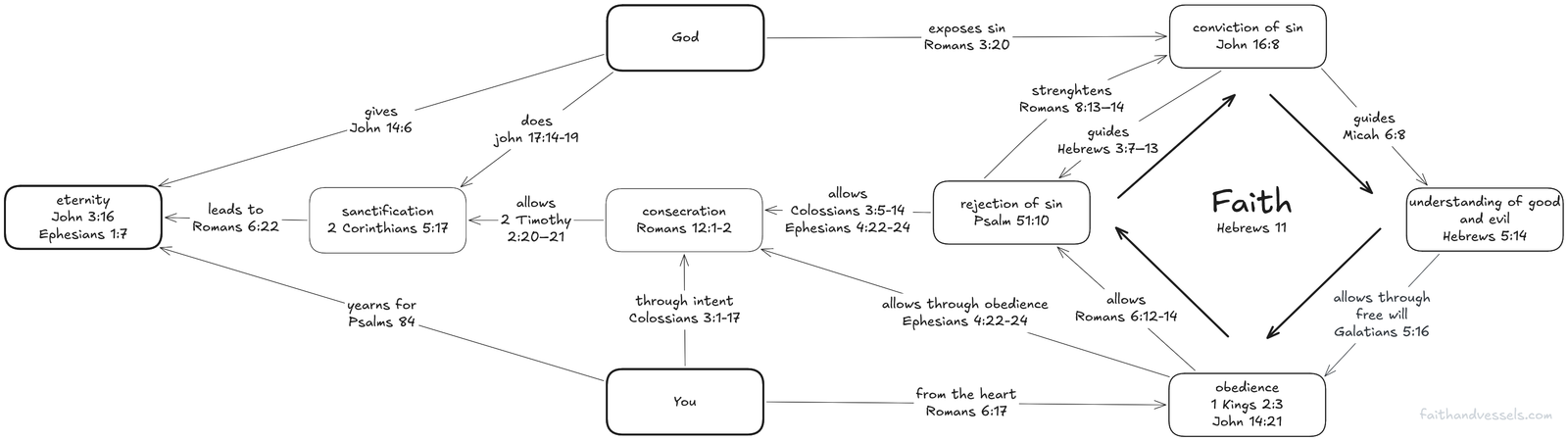
All my diagrams are built using bible verses and this one is no exception. This one illustrates what I see as two of the most important parts of the Christian faith :
- The wheel of faith illustrating the importance of understanding sin and then obeying and rejecting it.
- The path from consecration to sanctification and then to eternity that can only be done through obedience and rejection of sin.
For a lot of lukewarm Christians this suffices as in most of the cases what is compromised are obedience and rejection of sin. Often times lukewarms will negotiate with sin or at the very least entertain the thought of it whereas they absolutely should not.
- "I know I should not be doing this but God will forgive me anyway no ?" => James 4:4
- "This adult website displeases God I know, but I am single and I have my needs, surely He'll understand ?" => Romans 6:12–14
- "Is being a Christian simply just believing in God and living a 'good' life ? ( whatever 'good' is supposed to mean here )" => James 2:19
Yet a simple read of romans will show you just how dangerous this line of though truly is. Jesus had to pay the greatest price for our transgressions, this is to redeem us, not to allow us to live a 'good' life indulging in sin.
As show in the diagram, if you do not obey and reject sin then you are guaranteed not to be consecrating yourself to God and this is guarantee no to be sanctified by God and in turn have access to eternity be compromised and questioned.
I'll however warn against just seeing this as an equation as ultimately God has the final word in this matter and although faith without works is dead ( James 2:14-17 ), works need to come out of faith to be pleasing to God. This diagram is not intended for fearmongering, this would defeat the entire purpose by causing Christians to go from one extreme to the other. What I am attempting to get you as the reader to do is to be intentful about your faith and to not compromise with sin in a way that then compromises your relation with God. As Christians, we cannot not sin, we are humans and this is why we needed Jesus in the first place but there is a very important difference in between struggling with sin and indulging or tolerating sin.
There is a spiritual war going on all around us and the prize for this war is your soul. Yet, unlike any other war, you have your say as to who is winning this war for you.
I'm fairly confident in saying that if the apostle Paul where to write a letter addressed to today's church and Christians it would start with something along the lines of "Dear XXX, I pray that this letter finds you before I do and - for the love of everything holy - stop being stupid".
And he would then proceed to write a lengthy letter no one will forget for the next 2000 years or more as a cautionary tale and a sick burn.
Here is how these diagrams where made and how to read them :
When searching the bible I would find verses such as Romans 6:12–14 that links rejection of sin with obedience.
This gives me 2 concepts ( rejection of sin and obedience ) of witch I can make 2 boxes to represent them.

I can now add the romans verses in between as a relation and give it a verb to broadly represent how the relation links the two concepts.

Should the relation be in one direction just like in this case, an arrow is used to represent the direction.

The next step is to find the verses that describe the concept in more detail, here it would be Psalms 51:10 with Romans 6:15:18 for the rejection of sin and 1 Kings 2:3 with John 14:21 for the obedience.

I then add a verb of a very succinct description to tell what the relation is representing. Here it is just the verb 'allows' to show that the relation is critical ( you cannot reject sin with no obedience ).

From this point onwards I now look for other verses that link to the concepts in question. This then creates small enclosed areas.
Doing this a big more starts to form a mesh comprised of multiple concepts with their given relations
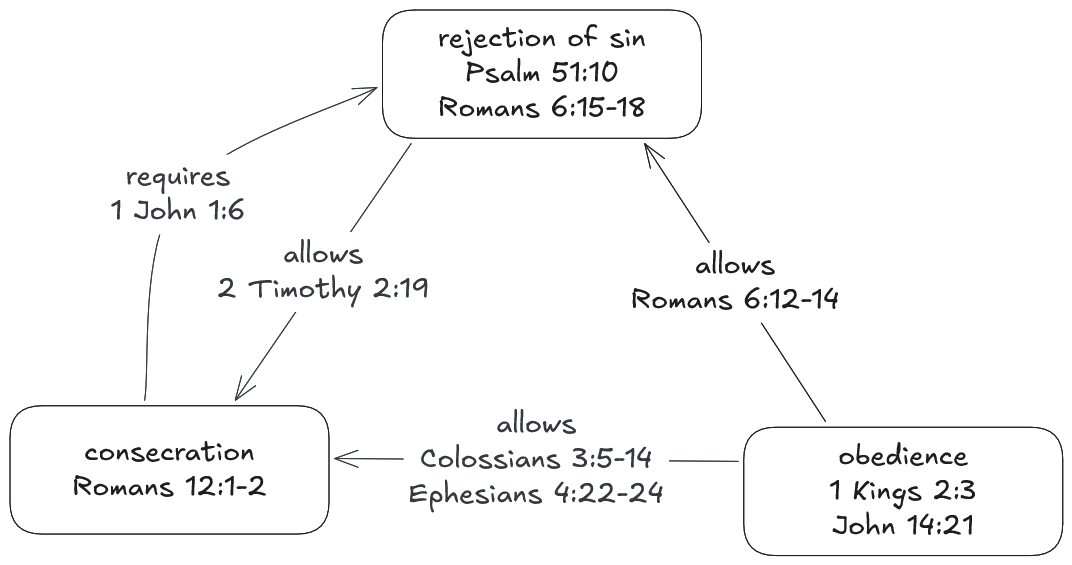
When multiple concepts are meshed together such as obedience / rejection of sin / consecration, I can look for verses that refer to the group. This gives me a theme that regroups the concepts. In this specific case it is the foundation of our faith referred to by Matthew 7:24-27 and Hebrews 11.
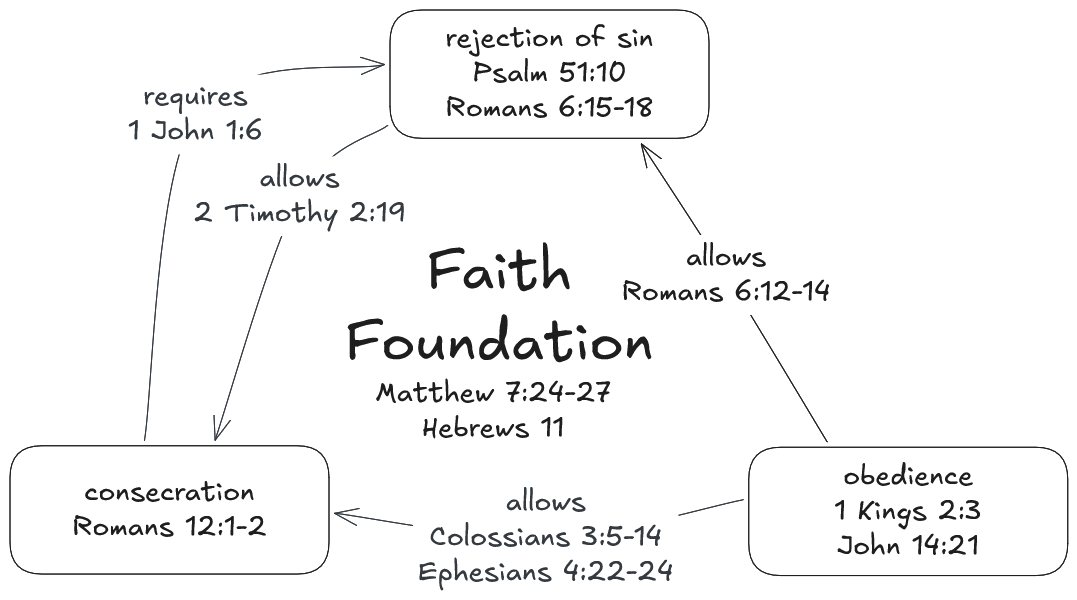
I then repeat the entire process multiple times over for all the concepts I find in a bid to see how they mesh together in a way that makes sense while attempting to remain readable.
This also starts to show some interesting patterns :
- Loops, you can see that parts of the faith reinforce and strengthen one another.
- The more a concept has relations going in and out of it, the more critical it is to our faith.
Once done - if everything was done correctly - I end up with a diagram that should show how the many components of the Christian faith mesh with one another. The end result will however vary depending on what I am attempting to illustrate ( the entire religion / the relation we have with God / how we grow as Christians / ... ).
Using the diagrams is straightforward : each diagram will tell you where to start on it's page and will show you the different links in between the concepts that make the Christian faith.
I very, very, very highly recommend that you have a bible open near you as you explore these diagrams that you may see what the verses are saying and why I chose them.
At each concept ( the boxes ) you can then ask : am I doing it properly ?
Let's take the example of the consecration where I chose Romans 12:1-2 as my verses of choice for an example.
The word 'consecration' is not used directly but the definition is given and the important part here is 'to present your bodies as a living sacrifice, holy and acceptable to God'. The next important step is to wonder if this is something you are doing properly or not and if so, why ?
Should a relation ( the arrows ) no longer be fulfilled then whatever it is pointing at may be broken in turn.
In the same manner, each concept has one or more relations pointing to other concepts. Should a concept fail as it is not done properly, any relation will instantly also fail and should the concept being pointed to in the relation depend on the first one, it then fails also.
Let's go back to the concepts of obedience and rejection of sin as I used them previously and see what happens there.
Should your obedience be partial as you are unwilling or unable to fully commit to the Christian faith, the obedience concept fails and can be crossed.
That said, note here that there is a huge difference in between doing your best and still failing Romans 3:23 versus considering yourself saved and not trying at all Romans 6:15:18 but that is precisely what is shown in the diagram.

Because obedience is compromised, the outgoing relation 'allows' Romans 6:12–14 is also bared as it depends on obedience.

In this scenario, because the relation is broken, the rejection of sin now also in a state where it no longer functions.
This checks out as you cannot reject sin if you are not obedient although the rejection of sin has a few more dependencies than just obedience.
Although it's a bit of a case per case, here the rejection of sin also gets crossed out.

This is how you end up with the religious equivalent of a loose strand on a fabric that you pull and the entire tapestry starts unraveling.
As a good exercise, I encourage you to test the following on the religion and relation diagrams :
- Where were the pharisees failing ? The pharisees where in lost in legalism but how does this manifest on the diagrams ?
- What was wrong with Job ? Job was most in the midst of moralism, how did that affect his relation with God ?
- Is there a point where you fail on the diagrams and why ?
The tool used to create and edit these diagrams is called Excalidraw, it's a free online tool. On each of the big diagrams you will see an 'Edit' button, this will open a new tab on your browser with the diagram, allowing you to experiment with it and try it out for yourself.
This can be especially interesting if you find it easier to learn through interactions, if you want to add some colours or if you want to add, subtract or shuffle a bit the diagrams.
It is important to note that whatever edits you may do on the diagrams are not saved. You need to save the file locally and then open it in excalidraw.com to be able to persist the edits.
Should you leave the page or refresh it, it will reset the diagrams
In both the religion and the relation diagram I have God and 'You' represented. I feel like it is important to detail some of the choices I had to make in this part.
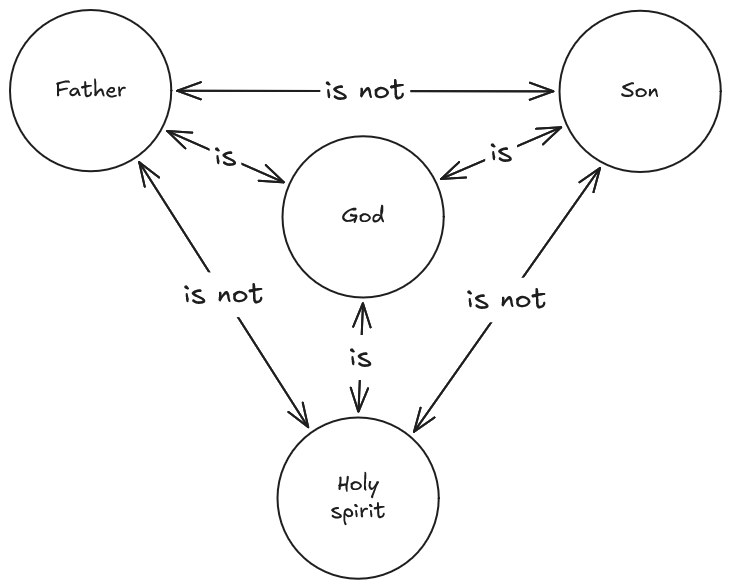
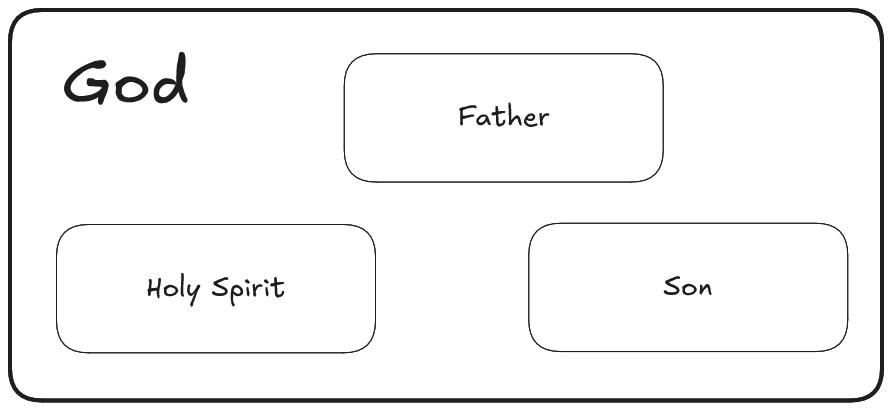
The trinity part is the easiest because the heavy lifting of explaining and detailing it has already been done. It's a well known topic and does not require elaboration here.
The most common representation of the trinity is called 'The shield of the trinity' as seen bellow and seems to date from at least 1200 AC according to Wikipedia. Turns out people have attempted doing diagrams for the Christian faith for a long time.
The 'You' though is considerably more blurry and gets considerably harder to appropriately put on the diagram, the different aspects that refer to us are that we can find in the bible are :
- the soul
- the spirit
- the mind
- the heart
- the flesh
- the vessel
Sometimes they can be even used interchangeably depending on the context making it even more difficult to distinguish them.
The most common definition of how we are made is the 3 circle diagram with the Body ( Soma ) encapsulating the Soul ( Psyche ) that in turn encapsulates the Spirit ( Pneuma ). This is a lesser form of the trinity and is the most widely accepted.
This topic is called biblical anthropology and is a rabbit hole in and of itself.
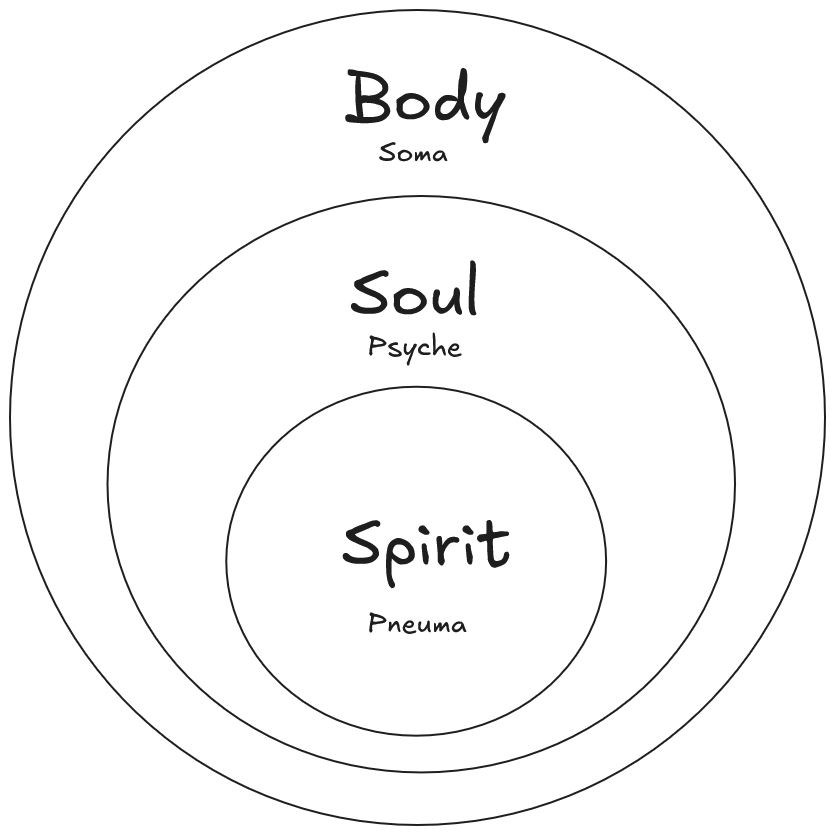
The verses that support this are Hebrews 4:12 and 1 Thessalonians 5:23 although there are some views that are also well defended that there is only one material ( the body ) and one immaterial ( the soul and spirit as one ).
These however, are not how I chose to represent God and 'You' in the diagrams as I was more interested in the interactions of the different aspect of the trinity on the religion and on the relation we have with God.
Thus, the trinity is still there but without the arrows in between the different parts and God is represented as a whole that encapsulates the 3 parts.
This is simply because I have a lot of arrows going back and forth and overlaying the shield of the trinity on top would make the diagrams considerably harder to read.
The representation of 'You' though strays completely away from the previous biblical anthropology diagram to put the soul and spirit in one concept, the body in another and the vessel and heart in a third.
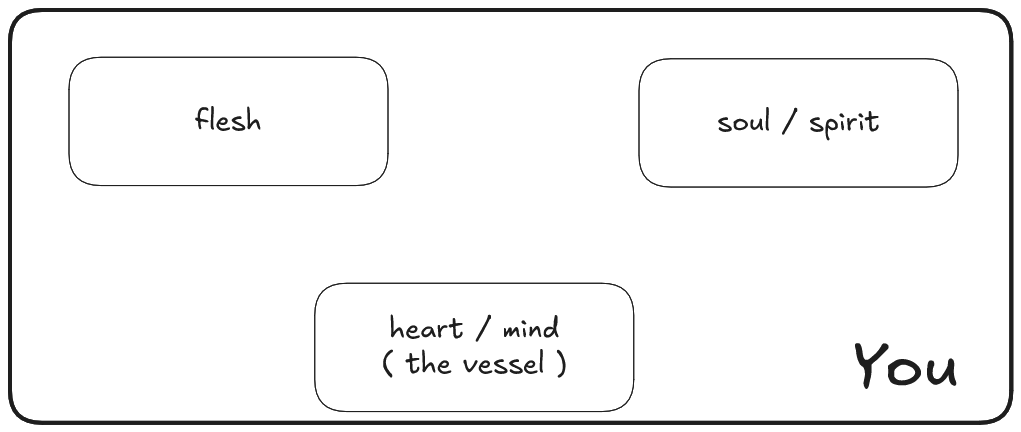
This is because I want to represent the inner turmoils we face attempting to follow Jesus and the intercessions and interventions from God that are neeed from him to help us get closer.
Thanks to this different approach, I can more easily show the inner conflicts described in Romans 7:21-23 and Romans 8:5-8 for the inner turmoil but also Galatians 5:13-26 for the fight in between the flesh and the Holy Spirit.
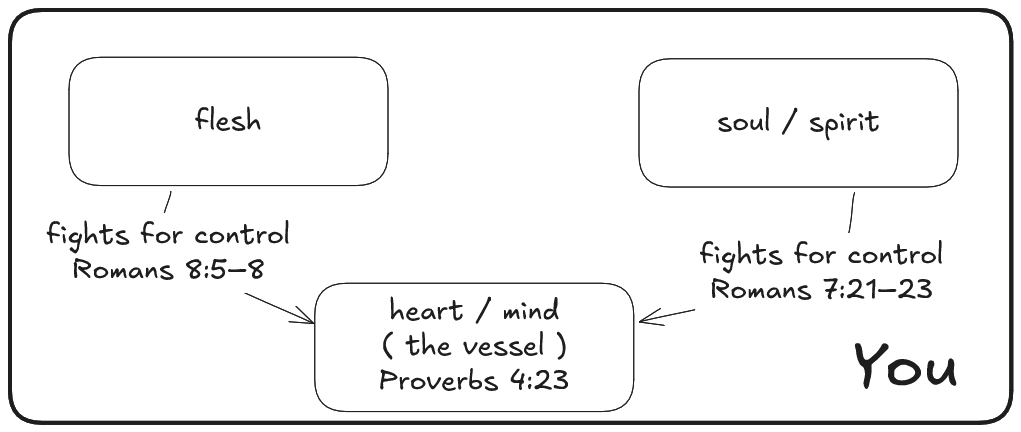
As you can see, the overall representation of the 'You' is not that different from the biblical anthropologic one, it just allows me to represent the same things for through a different angle.
Just as it is shown in scripture, these diagrams should never be taken as a source of truth without being tested and investigated through scripture.
Some very relevant verses showing so are 1 John 4:1, Acts 17:11 and Galatians 1:8-9 ( there are a few more but these 3 alone send a very clear message ). As a matter of fact, I will argue that the entire point of this website and these diagrams is to get lukewarm Christians to open their Bible and read it. So if testing these diagrams is what is needed to get them to do so, please do.
I did not introduce any errors intentfully should there be any, but I am a human and mistakes do happen. I did however reread and have the diagrams be tested by people with stronger theological backgrounds than me to weed out any issue that could be found in order to make proper diligence on the topic.
So as a conclusion : as you explore these diagrams, read your bible as you do so.
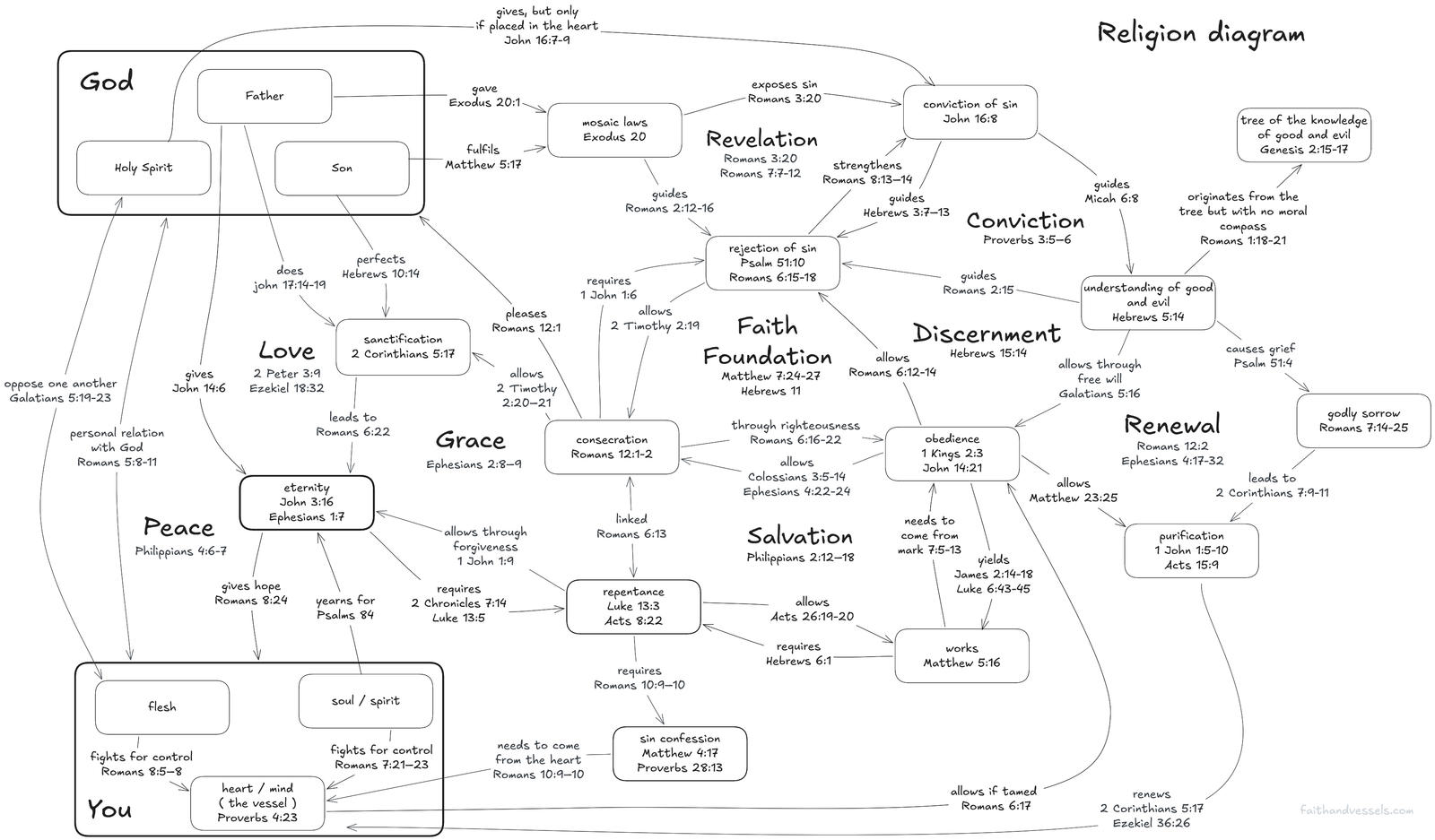
All the different components of the Christian faith
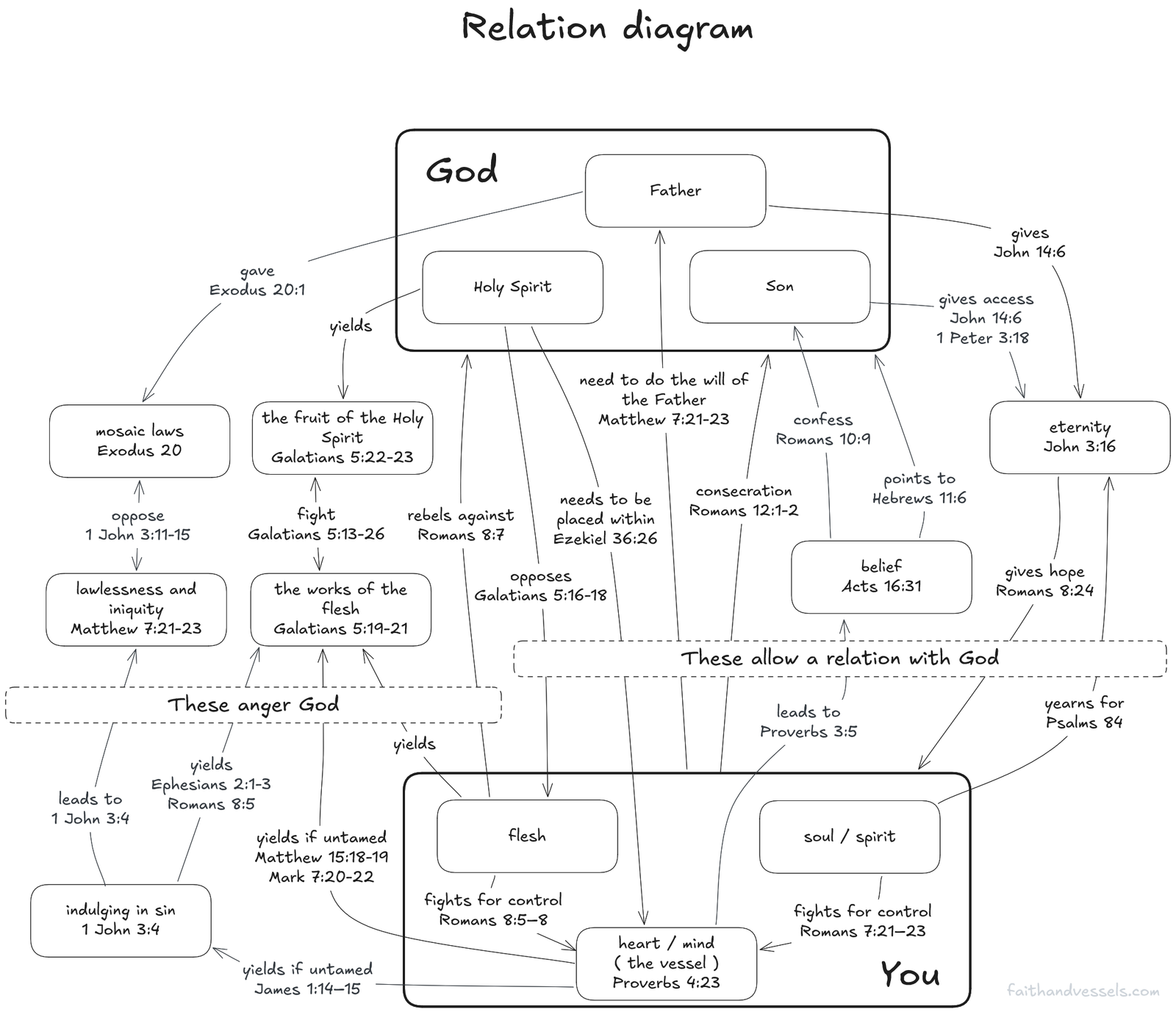
Our relationship with God
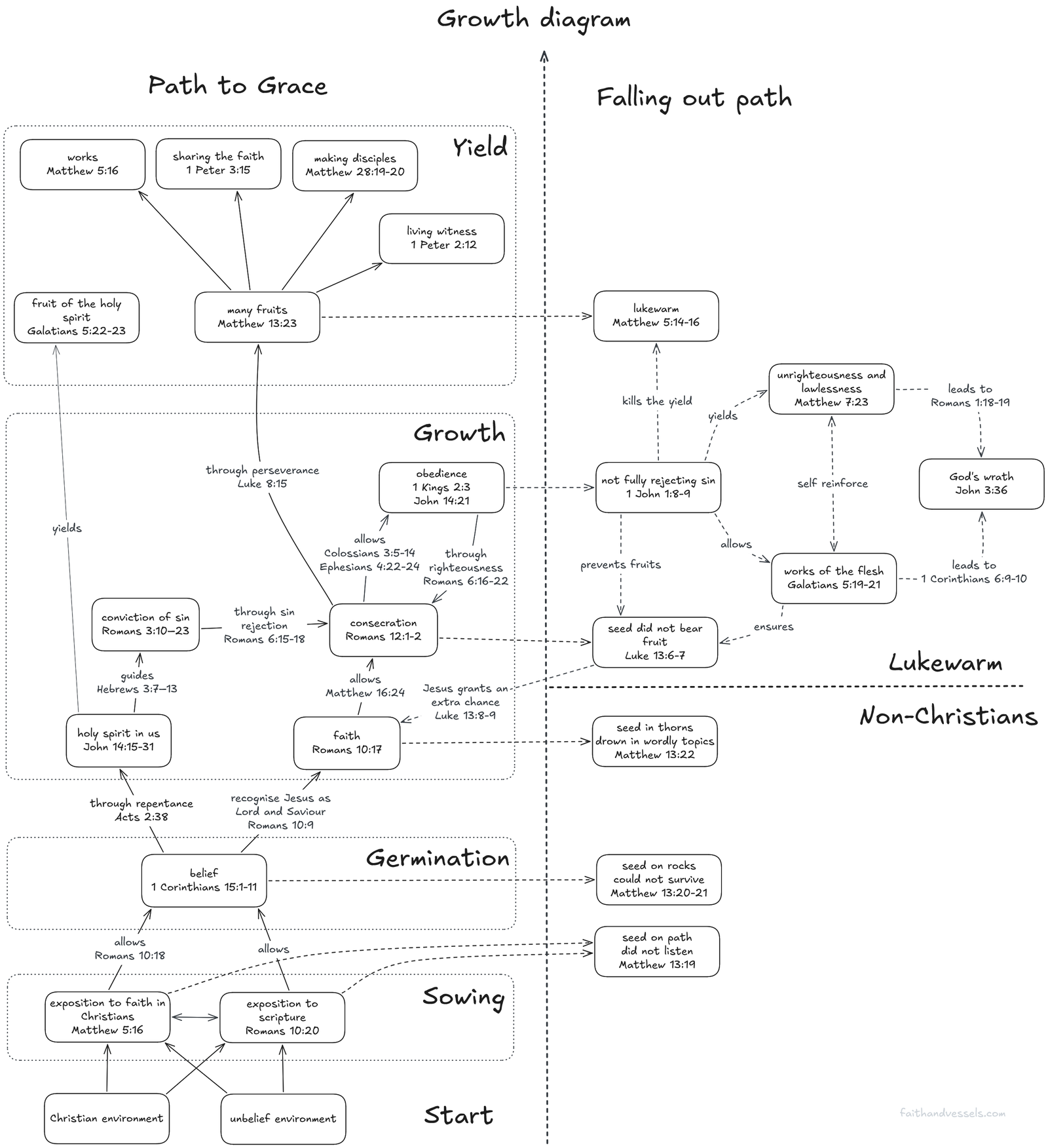
Going from unbeliever to Christian